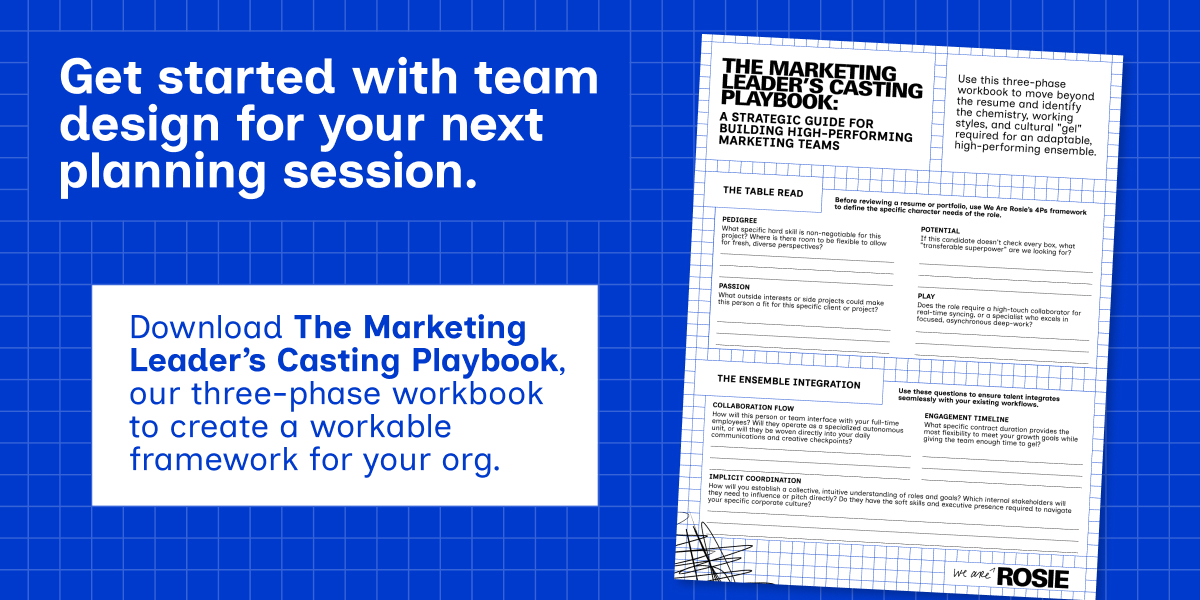
The Casting Advantage: Why Intentional Team Design is the Critical Skill for Marketing Leaders in 2026
Stop filling roles and start casting talent. Learn how the 4Ps framework helps marketing leaders build agile, high-performing teams built for 2026 and beyond.

share this article
Ready to unleash the full power of marketing?
Picture a Hollywood director prepping a highly anticipated summer blockbuster. The script is locked, the release date is set, and the stakes are enormous. But even with a massive budget and every element secured, the film’s success ultimately hinges on chemistry—that intangible spark that pulls viewers in. With the right casting, actors and crew elevate each other around a shared vision that shapes everything from performance to cinematography. That chemistry is what transforms a major production into an Oscar-worthy success.
Now, turn the lens to your marketing organization. The stage may be different, but the ambition? Exactly the same. As a marketing leader, you face stakes as high as any film premiere: aggressive growth goals, shifting algorithms, and relentless pressure to innovate. Add into the mix the latest AI tech, such as generative tools and predictive analytics, and suddenly your team’s script feels like it’s being rewritten every day.
At We Are Rosie, we’ve seen firsthand that tools alone don’t make a high-performing team. It’s the people that make the difference. That’s why marketing success in 2026 requires casting as part of purposeful team design. Casting entails crafting your roles, selecting the right talent, defining how they collaborate, and setting them up to gel from day one.
Now step into the director’s chair with us as your partner to help you assemble your winning team for 2026.
Why Marketing Teams Are Harder to Build Than Any Other Function
Some functions come with a playbook. Marketing doesn’t. Teams here are harder to assemble than in most corporate departments. When you pull back the camera and take a wider view, you’ll see that in many functions, structures are predictable. Join a finance team as a CFO—whether at a bank or a beverage company—and the roles, hierarchy, and expected outputs are mostly set. There’s a clear roadmap.
Marketing, by contrast, refuses to follow a script. Goals, tools, and audiences can pivot in an instant. There’s no such thing as a “standard” org chart. A high-performing marketing team in 2026 could include full-time employees, fractional talent, project-based creatives, and remote specialists.
“Marketing is messaging, emotion, and culture connecting with consumers,” explains Marie Lamonica, VP of Client Services at We Are Rosie. “It's fluid, so campaigns require varied perspectives and skill sets.”
As marketing accelerates every day, traditional team structures have a shorter shelf life. Instead of managing year-long campaigns, you’re likely adjusting budgets and talent for quarterly pivots, monthly shifts, or even a single project. When you start “casting” for specific needs, your focus shifts from filling roles to assembling a connected, adaptable ensemble. This is where innovation thrives—and it’s a strategy backed by organizational science.
How Organizational Psychology Drives Marketing Team Performance
Dr. Shonna Waters, PhD, an organizational psychologist and consultant, believes that your success as a leader depends on how you lean into the human element of your business.
“Organizations aren't technical systems. They're social systems,” Shonna notes. “You can have many experts and still not have an expert team. Team performance requires combining individual expertise in a way that creates shared goals, shared resources, and implicit coordination.”
Think of implicit coordination as your team moving in sync without you having to yell “cut” at every stage. That intuitive flow transforms a group of talented individuals into a cohesive cast. Shonna advises starting with your desired outcome and intentionally building a shared mental model: a collective, intuitive understanding of roles and goals.
When you cast for chemistry—what we call “team gel” at We Are Rosie—you’re fostering psychological safety and a culture of innovation. Psychologically secure teams adapt when the script changes and take the bold creative risks necessary to elevate the work. Research backs this up: Shonna points to studies that show teams with psychological safety consistently perform better and stay more engaged, and that workplaces that actively encourage innovation drive even higher results.
“Much of team success happens during setup, not execution,” Shonna points out. “Every team change, from someone joining or leaving, creates a new team.” Whether you're dealing with full-time staff or fractional talent, every arrival and departure reshapes the dynamic.
Connection, alignment, and trust—core tenants of intentional team design—have to start from day one. This approach is powerful because external talent brings a fresh vantage point that invigorates internal teams. “Fractional talent, with one foot in and one foot out, combines external insight with contextual understanding,” explains Shonna. “This allows ideas to be tailored to the organization’s culture, making creativity and change more likely to succeed.”
In other words: High-performing teams don’t happen by accident. They are designed with purpose, and they happen when you cast for connection.
How We Are Rosie’s 4Ps Framework Goes Beyond the Resume
You’re probably wondering: How do I actually bring this philosophy to life? How do I turn a feeling of chemistry into a reality?
Think of traditional hiring like casting a movie based exclusively on IMDb credits. You might know an actor’s past roles, but that tells you nothing about their personality, passion, or how they’ll actually show up on set. To move beyond the resume, We Are Rosie uses a proprietary casting philosophy called the 4Ps. This framework looks past the paper to evaluate talent through four distinct lenses to predict performance and chemistry.
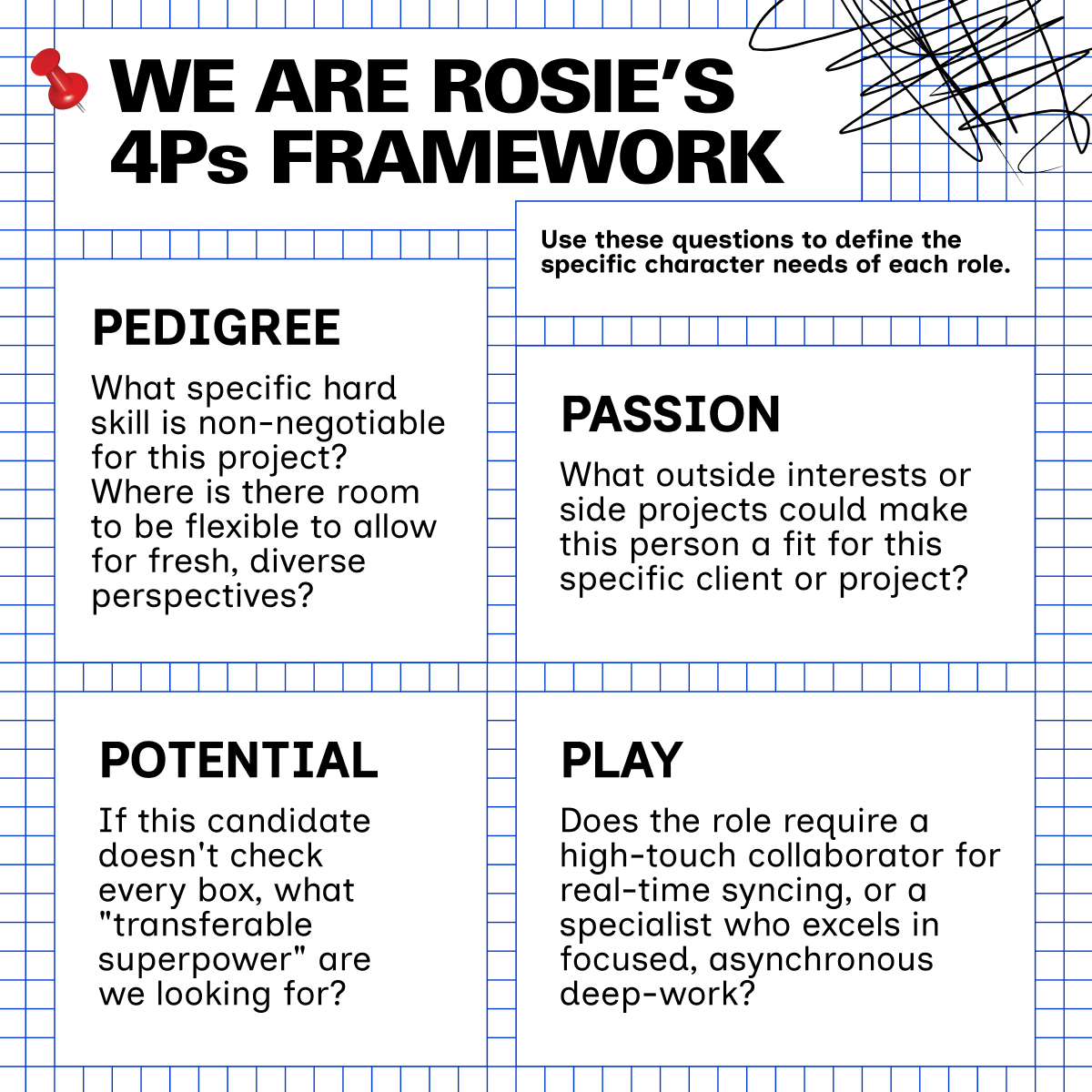
Pedigree is the foundation. Does the candidate have the experience? "Hard skills are essential. The job description has to be met," says Marie. "But we also need to think about the human as a whole.” Pedigree focuses on the quality and relevance of experience, not just years.
Passion is the spark. What connects a person to the role beyond the paycheck? Nicole Horton, a creative talent partner at We Are Rosie and self-described "matchmaking detective,” goes straight to the source. "I look for interests outside their work: photography, illustration, whatever it could be,” Nicole says. "Their hobbies or sense of humor help me better understand if they'd be a good fit for a certain client.”
Potential captures the wildcard factor algorithms often miss. Beyond the baseline requirements, people with diverse, well-rounded backgrounds bring a level of adaptability and fresh problem-solving to the table. “Maybe they don’t check every box, but they still bring something unique that could be transferable, like being a slam poetry champ,” Marie explains, adding that potential also includes AI curiosity: “Even if they aren’t AI experts, they should have the curiosity to treat new tools as creative partners.”
Play examines how someone prefers to work. This is the stage management of success. “Hours, async work, and time zones all play an important part,” says Nicole. When you solve for Play, you prevent mismatched expectations around communication, ability, and workflow.
What Intentional Team Casting Looks Like in Practice
How does this framework move from a concept on paper to a high-performing team? When the 4Ps are in action, the results speak for themselves. Here are three examples of the casting advantage at work:
Pioneering a Scalable Team Blueprint for a Global Tech Brand
For a global tech brand’s new flagship product, We Are Rosie built a fully remote social team of content creators, editors, and strategists to embed on a year-long contract. Elliot Ker, a video editor on the team, recognized the immediate value of this curated dynamic. Despite never crossing paths before, the team gelled instantly. "Our personalities definitely complement each other, which seems intentional," Elliot observed. (Spoiler alert: It absolutely was.)
To accelerate the Rosies’ shared mental model, the client traded screen time for face time by hosting a two-day, in-person meetup in Los Angeles for bonding and strategy. "It was nice to meet in person since we're scattered," Elliot shared.
Because the team was intentionally cast, they skipped the awkward adjustment phase and hit the ground running. One day they were creating executive-facing sizzle videos, and the next, they were developing content highlighting real human use cases. The client was so impressed with this experimental approach that they’re officially implementing this casting blueprint across other internal teams.
Driving Departmental Adoption Through Strategic Soft-Skill Casting
For a telecommunications giant, We Are Rosie assembled a team of campaign managers to build a brand-new department. While hard skills were essential, soft skills were the real key to success. Using the 4Ps, we actively avoided a "copy-paste" roster, instead matching stakeholders with Rosies whose personalities perfectly complemented their specific needs. A gentle, bridge-building professional helped one stakeholder embrace new processes, while a firm, decisive Rosie successfully drove adoption with another.
Since these teammates hadn't worked together before, we facilitated behind-the-scenes team building—like virtual lunches—to foster organic mentorship. “This empowered the team to problem-solve in a way that freed up the client,” explained Marie. “Driving those interactions help them get to know each other quickly, develop trust, and rely on each other, rather than having to ask the client one-off questions.”
Fast-Tracking High-Stakes Launches with an Elite Creative Duo
When a luxury kitchen brand geared up for several product launches and a massive, high-profile collaboration, they needed way more than just extra bandwidth. They needed a fresh set of eyes. To provide it, We Are Rosie deployed a highly specialized, luxury-focused creative duo to tackle the challenge. Instead of getting tangled in standard internal reviews, this dynamic duo took center stage. They pitched their concepts directly to the client's executive leadership and brought an elite-level of expertise that accelerated decision-making. “The client really trusted the Rosies to generate and deliver those bold ideas,” Marie notes. “That’s the beauty of the outside perspective.”
How Marketing Leaders Can Apply a Casting Approach to Team Design
By now, we hope you feel ready to step away from the outdated marketing hiring playbook and move your marketing organization into a new era. Between AI flipping the script on how we create content and the relentless push for brilliant campaigns, the pressure is definitely real. Here is the good news: you now hold the master script.
The We Are Rosie model proves that when you swap a rigid org chart for agile team design and human-centric talent casting, you put the perfect mix of perspectives exactly where they’re needed. You can inject every single project with authentic, undeniable Rosie energy. By putting human connection and team gel on the exact same pedestal as hard skills, you build a workforce that is agile, scalable, and unapologetically human.
Success as a marketing leader in 2026 means thinking exactly like a blockbuster director—focusing on chemistry, passion, and potential to assemble an ensemble that genuinely elevates the work. Nail the casting, and your campaigns won't just succeed. They’ll earn a standing ovation.